
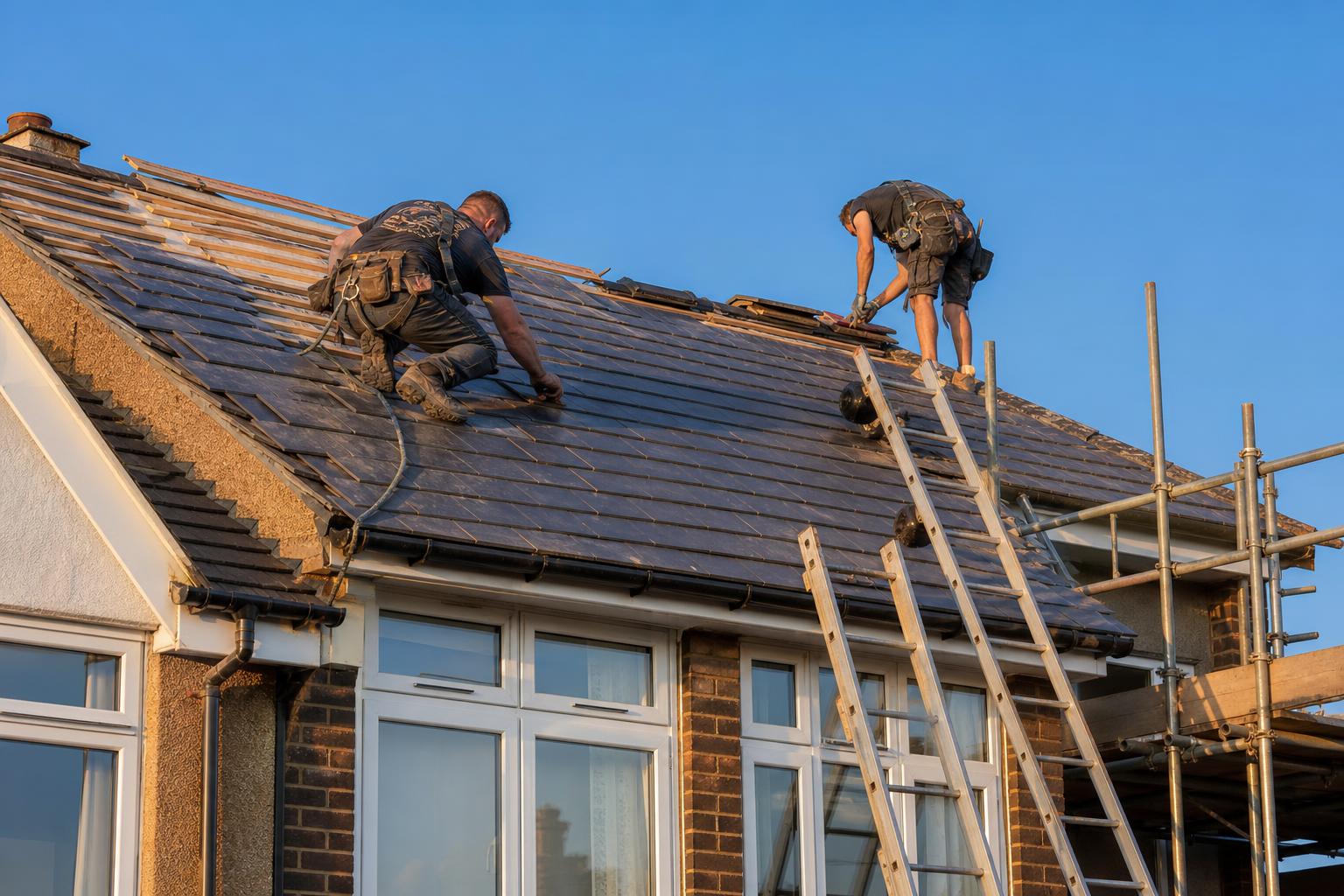
Leadwork & Flashing in Burnley Listed Building Owners
Listed-building roofs are heritage projects — the wrong repair is worse than no repair, and consent comes before quote.
How the leadwork & flashing job runs for listed building owners
We produce a heritage method statement before touching the roof, agree it with the conservation officer, and record every stage with dated photographs suitable for the LBC file.
Typical duration: 1–3 days depending on detail — bay roofs typically 2 days, single flashing replacements often a single day.
The brief we work to when the client is a listed building owner
On leadwork & flashing jobs for listed building owners, the priorities are usually predictable — and different from a walk-in domestic call. Here's what we plan around on a Burnley Grade II listed cottages job.
- Listed building consent process and drawings support
- Sourcing genuine reclaimed slate, clay pantile or handmade tile
- Traditional detailing — lime mortar, oak battens, lead rolls
- Conservation officer liaison and photographic method statements
- Non-destructive access and dust-controlled working
What you get in writing
Every leadwork & flashing job for listed building owners in Burnley closes with the same paperwork so nothing is verbal.
- Heritage method statement
- Reclaimed materials sourcing log
- Photographic stage record
- Post-works report for the LBC file
The leadwork & flashing work itself
Lead is the difference between a roof that lasts 50 years and one that leaks at every junction. We dress lead flashings around chimneys and abutments, form valleys, aprons and step flashings, and re-cover lead bay-window roofs in heritage code 5 lead with rolled joints — exactly the way they were originally built.
FAQs — Listed Building Owners in Burnley
- Do I need listed building consent for reroofing in Burnley?
- Any change to appearance or materials on a listed roof in Burnley typically requires LBC — we advise agreeing consent before pricing the reroof so the specification isn't wasted.
- Where do you source reclaimed slate and pantile?
- We work with established reclaim yards across the north and can supply provenance documentation for the conservation officer.
- Do you use lime mortar?
- Yes — hydraulic lime is used on solid-wall stack repointing and bedding where the original build used lime; we don't substitute cement.
- Will you liaise with our conservation officer?
- We attend site meetings with the conservation officer and issue the leadwork & flashing method statement in a format the LBC office will accept.
- How quickly can you get to Burnley?
- Same-day attendance for emergencies — we're based on Apex Close, BB11.
- What roofing issues are common on Burnley properties?
- Slipped Welsh slates on Victorian terraces; Stone chimney repointing and storm damage; Failed lead valleys on stone-built homes; Worn ridge pointing on exposed Pennine roofs.
Why listed building owners pick us
We regularly work on Grade II properties across the Ribble Valley, the Fylde and Pendle — always consent-led, always documented.
Related pages
Burnley at a glance
- Council
- Burnley Borough Council
- Postcode
- BB10/BB11/BB12
- Nearest A-road
- A671
- Motorway
- M65 J10
Trade zones nearby: Heasandford Industrial Estate, Network 65 Business Park, Shuttleworth Mead.
Local anchor: the Calder Valley below Pendle Hill.
Nearby areas we cover
- Padiham3 miles
- Nelson5 miles
- Accrington8 miles
Whether it's a single slipped tile or a full re-cover, every Burnley job gets the same approach: proper inspection, written quote, scheduled work, photographic record, written guarantee.